Ian Laval

furnituremaker
Vancouver Island,
British Columbia, Canada

 
      About trees and wood       About the Furniture      Contact Ian Laval (+ Other interesting web-pages)

 Gallery


Ian Laval has been designing and making individual pieces of furniture since 1970, starting at a workshop in northern England and moving more recently to British Columbia, Canada.  He uses only domestic timbers and for many years has been intimately involved in the processing of his wood from the tree onwards. His hallmark is the use of matched sawn veneers obtained from crotches, burrs and other interesting features found in native trees. Each piece is made by traditional hand methods, one at a time, with the meticulous attention to detail of the old-fashioned craftsman. Functional designs are all his own, using the natural beauty of native wood in delicate proportions refined over centuries and still right today. Larger pieces of Ian Laval's furniture are authenticated by an embedded silver signature specially cast and hallmarked in England.


Writing bureau in American walnut, 2008. Fall-front and drawers veneered with sawn walnut 
veneer quarters. Fall-front interior counter-veneered with sawn bird's-eye maple. Maple 
strings with sawn English walnut veneer inlays. Cabinet furniture in solid, hall-marked silver custom-made by Michael King, UK.


Detail showing (L) mitre-dovetail of the bureau main carcase -- a dovetail inside a mitre, one of the most demanding joints in high-quality furnituremaking.
 

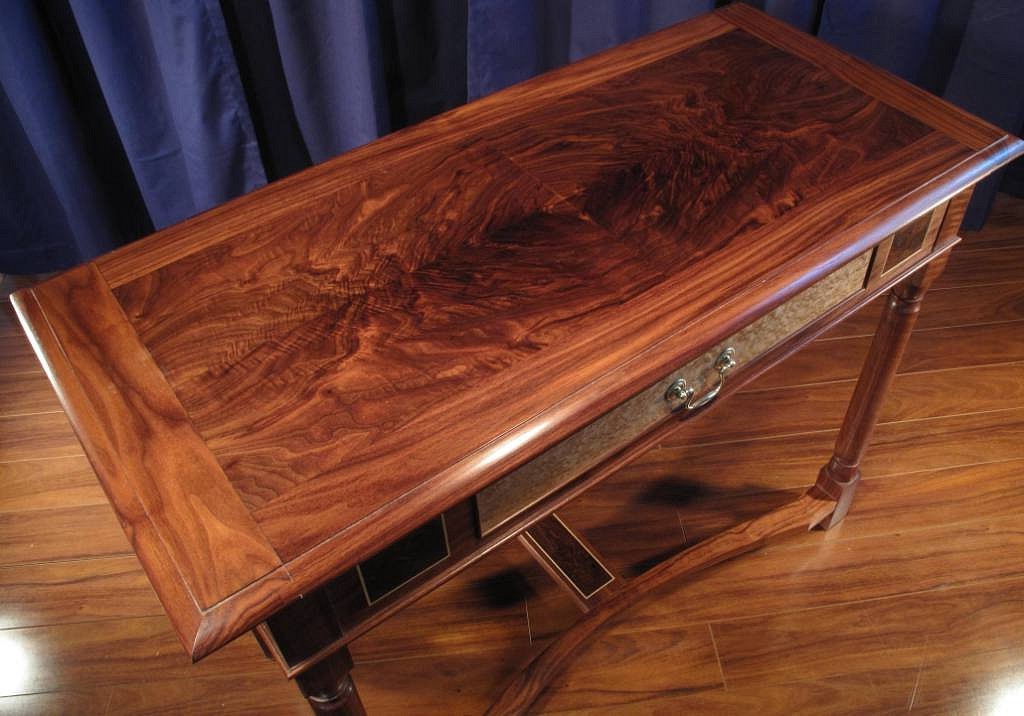
   Writing table. Eastern maple with English bog oak inlay in top. Drawer veneered with sawn English walnut burr and cock-beaded with bog oak.                                                                                


 Kitchen table in British Columbian Douglas fir. Approx. 78" x 30". Two drawers each side.


Bathroom vanity in British Columbian Douglas fir. Walnut inlay.

Queen bed in British Columbian Douglas fir. Plum & walnut inlay.


Ian Laval's work as a designer and cabinetmaker has devolved from an intense interest in the tree and the great variety of material it produces. He insists on being involved in all of the stages in the processing of his wood, from quarter-sawing, air-drying, kiln-drying and careful selection of each piece to fit the job it is required to do in traditional, hand-made furnituremaking.
He spent 29 years in England in a constant process of learning before moving to western Canada where he now has a workshop at Brentwood Bay on Vancouver Island, British Columbia.


The following pieces represent some of Ian Laval's work at  Meadowbank Farm, Curthwaite, Cumbria in northern England between 1970 and 1999. All of his timber came from trees in the surrounding countryside, mostly felled and all sawn by Ian Laval himself. Much of his work was in English oak, with a variety of other native species including walnut, yew, cherry, wych-elm, sycamore, ash, apple, pear etc. He is now discovering the working properties of some of the Pacific Northwest's native species, including Douglas fir, cedar, the wild and beautiful Garry oak of Vancouver Island and the often beautifully-quilted Pacific variety of maple.


Writing bureau.


Natural brown English oak. The fall-front is veneered and counter-veneered on a solid
oak ground  with 1/8-inch thick sawn brown oak
burr.

The main drawers are veneered with book-matched sawn brown oak burr

The interior is fitted with a small door and four small drawers of solid oak crotch.

Approximately 40 inches wide.


Writing bureau.


English cherry. Fall-front is veneered and counter-veneered with sawn cherry crotch.


The main drawers and interior drawers and door are veneered with sawn elm burr.


Approximately 40 inches wide.


Writing Bureau.


English oak. The fall is veneered and counter-veneered with book-matched sawn oak burr.

The main drawers are veneered with sawn oak burr. Sycamore inlay in lower frame.

Interior small drawers an d door are veneered with sawn oak burr and inlaid with sycamore.

Approximately 40 inches wide.


Writing bureau.


English oak. The main drawers are
veneered with sawn oak burr. The
inside of the fall-front is lined with
cow-hide.

Approximately 40 inches wide.

 
Writing bureau.

 English walnut. The fall is veneered and counter-veneered with sawn walnut crotch veneers taken from the same tree. The main drawers are similarly veneered.

The interior is inlaid with sycamore.
Cabinet furniture is specially-cast in solid silver with an English hall-mark.

Approximately 40 inches wide.


Table.


Curly ash. The top is inlaid with
black bog oak and the drawer cock-beaded with walnut.

Approximately 30 inches wide by
30 inches high.


Hall table.

English oak. The top and frame are inlaid with sycamore and sawn oak burr veneer.

The drawer in veneered with sawn oak crotch.

Approximately 40 inches long.


Sewing/jewellery box.


English walnut. The drawers are veneered with sawn sycamore crotch.

Handles are bog oak with
sycamore inlay.


Music stand.


Cherry. The centre panel is
veneered with sawn elm
burr veneer. The spindles are
bog oak.


Table.


English oak. The drawer and frame are  veneered with sawn oak crotch. The frame has sycamore inlays.

Approximately 32 inches long by 30 inches high.


Corner cabinet.


Cherry. The top rail is inlaid with
sawn elm veneer and bog oak strings.

The door panel is inlaid with bog oak.

Approximately 38 inches high.


Corner table.


Cherry. The top and frame are inlaid with bog oak.

The drawer is veneered with sawn elm veneer.


Chest-on-stand.


Curly ash with sawn walnut
veneers and bog oak inlays.

The drawer handles are cast, hallmarked silver.

Approximately 44 inches long.


 Dressing table and stool.

 English oak with sawn oak
burr veneers and sycamore
inlay.

The folding mirror is framed
in sycamore with a bog oak
handle.

The stool is upholstered with
cotton tapestry.

Approximately 42 inches long.


Pedestal desk & carver chair.

English oak. The desk drawers
are veneered with sawn oak
burr veneers.

The chair is in English oak with sycamore inlays in the yoke
and a cotton tapestry seat.
..

Approximately 72 inches x 26 inches


Gateleg dining table.

English oak. Two cockbeaded drawers, each veneered with
sawn oak burr.

Approximately 66 inches by
50 inches.


Display cabinet.


English oak with sawn oak burr veneers and sycamore inlays.

Approximately 66 inches high.


Sideboard.


English oak with sycamore
 inlays.

Approximately 60 inches
long.


Cabinet mirror.


Walnut. Handles are in cast
silver with an English hallmark.


Low table.


Wych elm. The drawers are veneered with sawn elm burr and the top inlaid with bog oak.

Approximately 40 inches long.


Hall table.


English brown oak. Top veneered with book-matched sawn oak
burr quarters, inlaid with bog oak and banded with sawn sycamore veneer.

The drawer and frame have
sawn oak veneer and sycamore inlay.

Approximately 33 inches long.


Long-case clock


English walnut from a single tree blown down in a gale at Dalston churchyard, Carlisle, Cumbria.
The movement and brass face were specially made in the UK. The
moon-face is enamelled.


Bow-front corner cabinet.


English cherry.

Approximately 39 inches high.

Dining table

English oak with sycamore inlay.

Approximately
96 inches long.

Traditional English writing bureau.


English oak. The interior door and drawers are veneered with sawn oak burr.


Approximately 34 inches wide.

Writing bureau.


English yew.

Approximately 34 inches wide.

Hall table.


English oak with sycamore inlay.

Approximately 34 inches long.

Chest-on-stand.


Natural brown English oak.

Drawer veneered with sawn brown oak burr.

Approximately 48 inches wide.

  Oak bed.


laval web design